Stress, Sleep and Heart Health
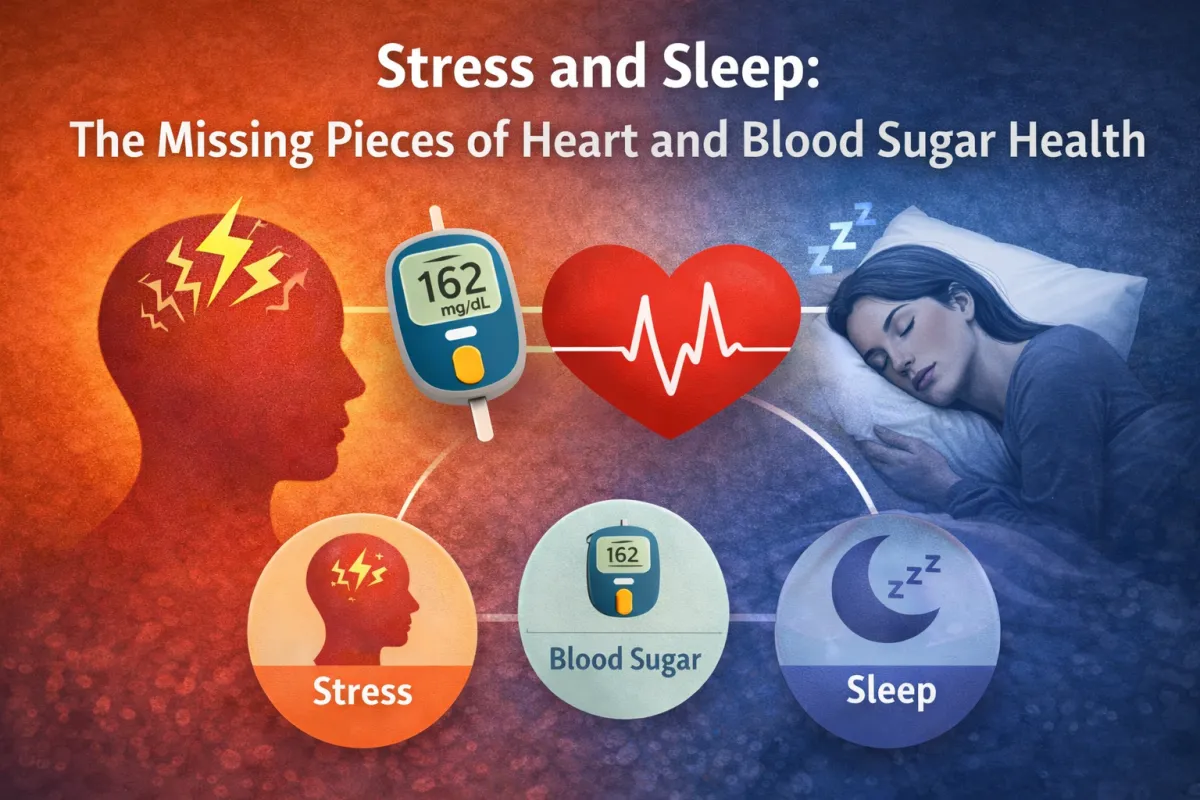
Stress and Sleep: The Missing Pieces of Heart and Blood Sugar Health
When people work on heart health or blood sugar, they usually focus on food and exercise first.
Those matter—but they are not the whole picture.
Two of the most powerful drivers of both heart disease and blood sugar dysregulation are often overlooked:
stress and sleep.
You can be eating well and still feel stuck if these two areas are not supported.
How Stress Affects Blood Sugar and the Heart
Stress is not just emotional—it’s biological.
When your body perceives stress, it releases cortisol and adrenaline. These hormones are designed to help you respond to danger, but in modern life they are activated far too often.
Cortisol:
raises blood sugar by signaling the liver to release glucose
increases blood pressure
promotes insulin resistance when chronically elevated
contributes to inflammation in blood vessels
Over time, this constant stress response places strain on both the metabolic system and the cardiovascular system.
This is why stress is now recognized as a major risk factor for heart disease—not just an emotional issue.
The Sleep–Blood Sugar Connection
Sleep plays a critical role in how the body regulates glucose and repairs blood vessels.
When sleep is inadequate or inconsistent:
insulin sensitivity decreases
fasting and post-meal blood sugars rise
appetite hormones shift, increasing cravings
inflammation increases
blood pressure becomes harder to control
Even a few nights of poor sleep can worsen blood sugar control and cardiovascular markers.
This explains why people often see higher glucose readings after nights of short or disrupted sleep—even without dietary changes.
Why Stress and Sleep Are So Closely Linked
Stress and sleep influence each other.
High stress makes it harder to fall and stay asleep.
Poor sleep makes the body more reactive to stress the next day.
This creates a cycle:
stress → poor sleep → higher blood sugar → more stress → worse sleep
Breaking this cycle doesn’t require perfection—it requires gentle, consistent support for the nervous system.
Supporting Stress and Sleep Without Overhauling Your Life
You don’t need to eliminate stress or sleep perfectly to see benefits.
Small actions can significantly improve regulation:
keeping meal times consistent
getting morning daylight exposure
going to bed 30 minutes earlier
creating a simple wind-down routine
practicing slow breathing before meals
reducing screen time at night
These behaviors send signals of safety to the body, which helps lower cortisol and stabilize blood sugar.
Why This Matters for Long-Term Heart Health
Chronic stress and poor sleep contribute to:
higher blood pressure
higher blood sugar
increased inflammation
increased cardiovascular risk
Supporting stress and sleep improves not only daily glucose readings but also long-term heart outcomes.
Heart health is not just about what you eat—it’s about how your body processes stress and recovers each day.
The Takeaway
If you’re focusing only on food and exercise, you may be missing two of the most important pieces of heart and metabolic health.
Supporting stress and sleep helps:
steady blood sugar
reduce inflammation
protect blood vessels
improve overall cardiovascular resilience
Small, steady changes—not perfection—create meaningful results.
References (Evidence-Based)
American Heart Association.Stress and Heart Health.
https://www.heart.orgADA Standards of Care in Diabetes—2024.
Sleep, stress, and glycemic control.
https://diabetesjournals.orgSpiegel K, Leproult R, Van Cauter E.
Impact of sleep debt on metabolic and endocrine function.
The Lancet, 1999.Knutson KL et al.
Sleep duration and cardiometabolic risk.
Circulation, 2010.McEwen BS.
Stress, adaptation, and disease.
Annals of the New York Academy of Sciences, 1998.
